Tank vs Tankless Water Purifiers: Which Should Distributors Sell?
By Li-Men Editorial Team · October 17, 2026
When a distributor builds a range of reverse osmosis (RO) water purifiers, one of the first decisions is whether to offer models with a pressure tank or tankless models. Both purify water on the same principle, but they behave differently in the customer's kitchen, during installation and at the point of sale. This guide summarizes the differences so you can build a range that sells in your market.
How each type works
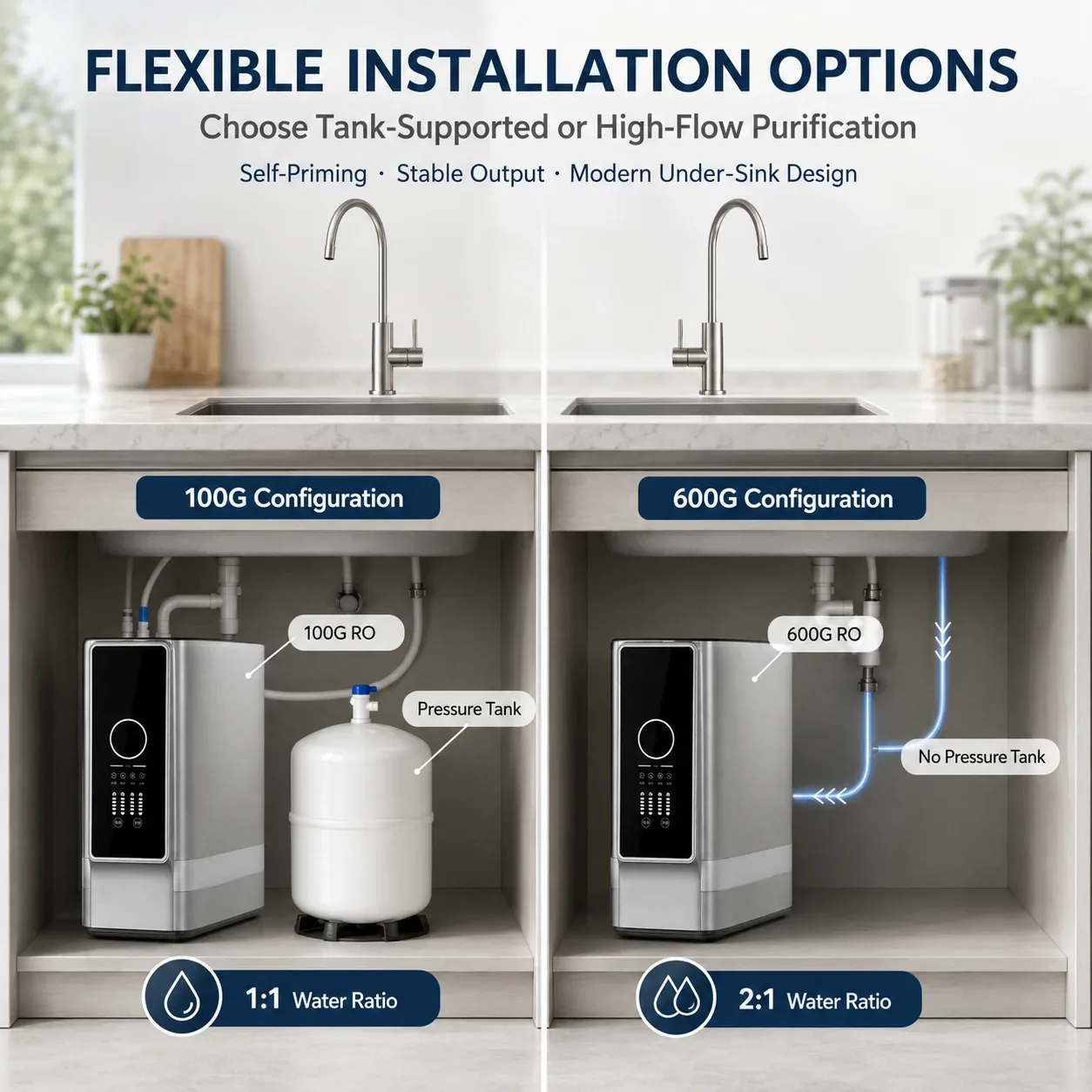
Tank models. The unit produces purified water slowly and stores it in a pressurized tank. When the user opens the faucet, the stored water comes out. That is why tank models usually have lower capacities, such as 100 GPD (gallons per day): they do not need to produce a lot of water instantly because the tank acts as a reserve.
Tankless models. The unit purifies water at the moment the faucet is opened, with the help of a booster pump. To deliver a comfortable flow, these models work at higher capacities, such as 400G, 600G or 800G, and they need a power connection.
Quick comparison
| Aspect | With tank | Tankless |
|---|---|---|
| Space under the sink | Needs room for the unit and the tank | One body, easier to fit |
| Water availability | Tank reserve; flow drops as the tank empties | Continuous flow while the faucet is open |
| Typical capacity | 100 GPD | 400G to 800G or more |
| Power | Depends on the model | Required (booster pump) |
| Hygiene | The tank must be kept clean | No water stored in a tank |
| Retail price | Usually more affordable | Usually higher |
Which customer asks for which
- Apartments and small kitchens. Under-sink space is the limit. A compact tankless unit is usually the best answer.
- Families with high consumption. They use purified water for drinking and cooking several times a day. A 600G or 800G tankless unit means the water does not “run out”.
- Price-sensitive customers or areas with frequent power cuts. A 100 GPD tank unit remains a solid, easy-to-explain option, and the water already stored in the tank stays available during a power cut.
- Small offices. It depends on headcount; for continuous use, a higher-capacity tankless model is the better fit.
Examples from our range
- Tank, 100 GPD: the M29-RO100 has 5-stage RO filtration, a 2.8-gallon tank and a compact 375 × 330 × 480 mm cabinet. The M30-RO100 uses the same filtration with an optional display control box.
- Tankless, 600G: the C03 combines a composite filter and an RO membrane with quick-change filters; the C05 uses universal PP, activated carbon and RO filters that are easier to source locally.
- One series that covers both: in the M02 and the M11, the 100G version uses a pressure tank and the 400G–800G versions are tankless, so you can offer both types with one design.
How to build a range of 2 to 4 models
- An entry-level tank model (100 GPD) for customers who compare on price.
- A 400G or 600G tankless model as your main household product.
- A higher-capacity or display model for customers who want convenience or a more modern look.
- If your market relies on independent installers, consider a model with universal filters, because replacement cartridges are easier to find.
A short range keeps your spare-parts inventory focused and makes it easier to train your sales team.
Questions to ask the manufacturer before requesting a quote
- What is the real capacity (GPD) and flow rate of each version?
- What is the pure-to-waste water ratio?
- What voltage and plug type does the pump use, and can it be configured for my market?
- Are the filters proprietary or universal, and how often are they replaced?
- What is the minimum order quantity for the standard model and for a version with my brand?
Conclusion
There is no single answer: tank units remain an affordable entry point, while tankless units are a better fit for small kitchens and high consumption. Most distributors sell best with a short range that combines both.
Building your range? Send us your market, customer type and estimated quantity, and we will recommend suitable models. Standard models can be ordered from 10 units.