How to Launch a Private-Label Water Purifier Brand: A Step-by-Step Guide
By Li-Men Editorial Team · October 17, 2026
More and more distributors want to stop depending on third-party brands and sell their own water purifier brand. A private label gives you control over pricing, brand image and the relationship with your end customers — but it needs to be planned well. This guide walks through the steps from idea to first order.
Step 1: Define your market, price point and channel
Before talking to any factory, answer three questions:
- Who will you sell to? Households, offices, retailers, installers.
- What price range do you want to be in? This decides which models make sense.
- Through which channel? Physical stores, online, installers, projects. Each channel needs different packaging and sales materials.
Step 2: Choose a few base models
It is better to start with 2 to 4 well-chosen models than with a large catalog. For example:
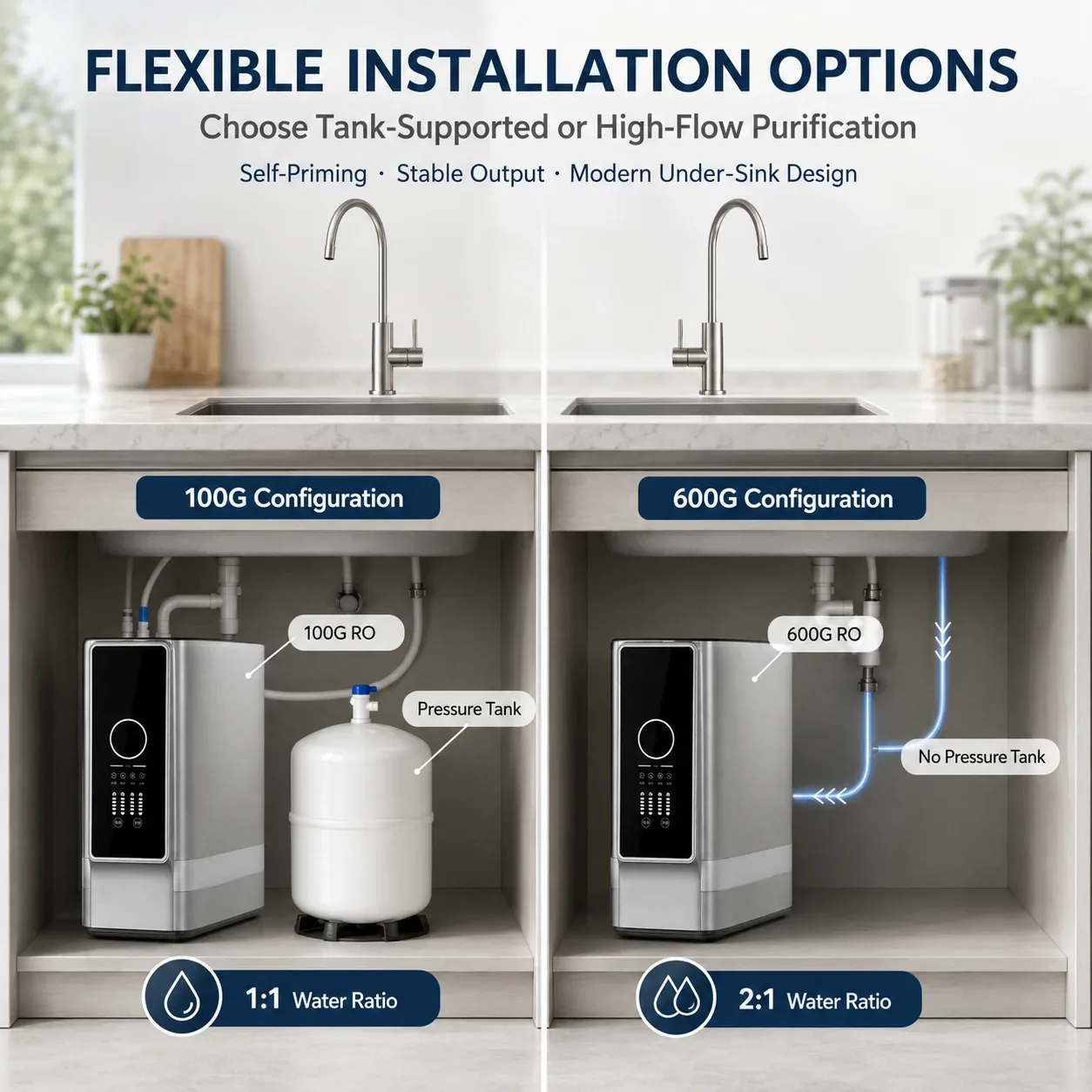
- an entry-level tank model (100 GPD);
- a main tankless model (400G to 600G);
- a display or higher-capacity model;
- if you sell to businesses, a higher-flow system.
Fewer models mean less spare-parts inventory and a better-trained sales team. If you are unsure between tank and tankless units, see our guide on that topic.
Step 3: Decide your level of customization
Not every private-label project needs the same thing. These are the levels we work with and the minimum order quantity (MOQ) for each:
| Level | What it includes | Minimum order |
|---|---|---|
| Standard model | A unit from our range, unchanged | From 10 units |
| Basic branding | Your logo on the unit | From 50 units |
| Custom appearance | Custom front panel or housing | From 100 units |
| Custom color box | Printed box with your design | From 500 units |
| Full private label with standard packaging | Your brand while keeping our standard packaging | From around 100 units (negotiable) |
A common strategy is to start with basic branding (your logo on the unit) to test the market, then move to a custom box once volume justifies it.
Step 4: Adapt the product to your market
- Voltage and plug. These can be configured to project requirements — for example 110–120 V / 60 Hz with US-type plugs or 220–240 V / 50 Hz with European plugs. Availability depends on the model, so mention it in your first inquiry.
- Language. Plan the manual, labels and sales materials in your customers' language.
- Spare parts. Decide from the start which filters you will stock and how often you will reorder them.
Step 5: Samples and approval
Before ordering, request samples of the chosen models and review them with your team and, if possible, a few trusted customers:
- performance and flow;
- ease of installation;
- finish and logo quality;
- clarity of the manual and labels.
Put everything you approve in writing: model, configuration, colors, logo position and packaging. This avoids surprises in production.
Step 6: Prepare your first order
- Confirm the quantity per model and the customization level (each has its own MOQ).
- Agree on pre-shipment inspection: what is checked and how it is documented.
- Plan logistics and import with your customs broker.
- Prepare your launch: photos, product sheets and training for salespeople and installers.
Lead times depend on the customization level and the season, so ask for a concrete schedule when you confirm the project.
Common mistakes
- Starting with too many models and ending up with slow-moving stock.
- Designing a custom box before knowing whether the model sells.
- Not defining the market's voltage and plug type from the start.
- Forgetting spare parts: a customer without replacement filters is a lost customer.
Conclusion
Launching a private-label water purifier brand does not require large volumes from day one. With a few well-chosen models, step-by-step customization and approved samples, you can test your market with reasonable risk and grow from there.
Want to assess your private-label project? Send us your market, the models you are interested in and your estimated quantity, and we will tell you which customization options apply and the minimum order for each.