Commercial RO System Specification Checklist: What B2B Buyers Should Provide Before Requesting a Quote
By Li-Men · September 11, 2026

Selecting a commercial reverse-osmosis system should begin with project data, not a nominal capacity figure alone. Before requesting a quotation, document the feed-water conditions, required product-water quality, daily and peak demand, operating schedule, site utilities, pretreatment needs, destination market and required compliance evidence.
This checklist is designed for distributors, importers, private-label brands and commercial-project buyers preparing an initial request for quotation. It is not a substitute for a site assessment, water analysis or application-specific engineering review.
What information is required before sizing a commercial RO system?
A useful commercial RO enquiry contains seven groups of information: feed-water data, product-water requirements, demand profile, pretreatment conditions, site utilities, destination-market requirements and the evidence expected from the supplier. Missing information should be identified as an open item rather than replaced with an assumption.
| Input | What to provide | Why it matters |
|---|---|---|
| Feed water | Source, recent analysis, TDS or conductivity, hardness, turbidity, pressure and temperature | Influences membrane selection, pretreatment and expected operating conditions |
| Product-water target | Intended use and required water-quality specification | Defines what the treatment process must achieve |
| Demand profile | Daily volume, peak flow, operating hours and usage pattern | Separates total demand from short-term demand |
| Pretreatment | Existing filtration, softening, dosing and disinfection | Identifies scaling, fouling and compatibility questions |
| Installation site | Space, power, feed connection, drain, storage and service access | Determines whether the configuration can be installed and maintained |
| Market and compliance | Destination country, application and required documents | Keeps document requests tied to the actual product and claim |
| Commercial scope | Quantity, customization, packaging, manuals, spares and schedule | Defines a comparable quotation scope |
1. Define the feed-water conditions
Start by identifying the source: municipal supply, borehole, surface water or another pretreated stream. Attach a recent laboratory report when available. At minimum, discuss TDS or conductivity, hardness, turbidity, temperature and available inlet pressure. If the project has known concerns such as iron, manganese, silica, chlorine or microbiological risk, record them instead of assuming that an RO membrane alone resolves the complete treatment requirement.
Feed-water data affects pretreatment, operating pressure, cleaning requirements, recovery assumptions and expected consumable life. A quotation prepared without this information should clearly label its assumptions and exclusions.
2. Define the required product-water quality
State what the treated water will be used for and which specification it must meet. Drinking-water service, food preparation, hospitality, equipment feed water and industrial processes can have different acceptance criteria. Avoid requesting “pure water” without defining a measurable requirement.
Where a contaminant-reduction or performance claim is important, ask which exact model and configuration support that claim. NSF explains that water-treatment standards cover different effects. For example, NSF/ANSI 58 addresses point-of-use RO-system requirements including material safety, structural integrity, TDS reduction and specified performance claims. Check the standard together with the listed product and claim, not as a general quality ranking.
3. Separate daily demand from peak flow
Daily consumption and peak demand answer different questions. Daily volume helps establish how much product water must be generated over an operating period. Peak flow describes how quickly water is needed at the busiest moment. A system may produce sufficient water over a full day yet still require storage and delivery capacity to meet a short, concentrated demand period.
Provide expected operating hours, number of shifts, peak-use window and whether consumption is continuous or intermittent. If storage is allowed, include available tank space and required reserve.
4. Confirm pretreatment and reject-water planning
Commercial RO systems should be evaluated as part of a treatment train. Sediment, hardness, oxidants and other feed-water characteristics can affect membranes and components. Correct pretreatment depends on the water analysis, equipment materials and operating target; it should not be copied from an unrelated project.
Identify where reject water can be discharged or reused, subject to local requirements. Ask the supplier to state the assumed recovery basis and expected reject-water volume under proposed operating conditions.
5. Document the installation site
Provide a simple site plan or photographs showing the equipment area, access route and nearby connections. Confirm footprint and height, electrical supply, feed connection, drainage, ventilation, ambient conditions and maintenance clearance. Note whether storage tanks, booster pumps or distribution equipment are inside or outside the supplier's scope.
6. Verify compliance and supplier evidence
Ask for documents that match the destination market, application and exact proposed model. Check the document holder, issuing body, model numbers, applicable standard or directive, issue and expiry dates, and the scope of the verified claim. A document for one component or product family does not automatically cover every product sold by the same company.
Management-system certification and product certification serve different purposes. ISO describes ISO 9001 as a quality-management-system framework, while product standards address particular product requirements and claims. Supplier evaluation may combine document review, second-party assessment and third-party certification rather than relying on a logo alone.
Li-Men publishes a certificate and test-report index identifying applicable product types, models and document status. Buyers should still confirm which documents apply to the proposed equipment.
7. Compare quotations using the same basis
A lower headline price does not necessarily represent the same system scope. Ask vendors to identify assumptions, optional items and exclusions.
| Comparison point | Question to ask |
|---|---|
| Rated output | Under which feed-water temperature, pressure and quality conditions is output stated? |
| System boundary | Are pretreatment, storage, pumps, controls and installation included? |
| Consumables | Which filters, membranes and chemicals are required? |
| Monitoring | Which pressure, flow, conductivity or alarm functions are included? |
| Documentation | Which manuals, drawings, test records and market-specific documents are supplied? |
| Commercial terms | What are the production assumptions, packaging, delivery terms and exclusions? |
| Support | What commissioning guidance and spare-parts support are available? |
Copy-and-use commercial RO request-for-quotation checklist
If an item is unknown, mark it as “to be confirmed” so the supplier can identify the next information required.
- Project and application: installation type, intended water use and destination market.
- Feed-water source: municipal, borehole, surface water or other.
- Water analysis: report date, TDS or conductivity, hardness, turbidity, temperature and known concerns.
- Product-water target: required quality specification and monitoring method.
- Demand: daily volume, peak flow, operating hours and storage allowance.
- Existing treatment: filtration, softening, dosing, disinfection and storage.
- Utilities: inlet pressure, power supply, feed connection and drainage.
- Space: equipment-room dimensions, access limits and maintenance clearance.
- Required scope: pretreatment, RO unit, storage, delivery pumps, controls, spares and commissioning support.
- Compliance: standards, certificates, test reports, manuals and destination-market documentation.
- Commercial details: quantity, OEM/ODM requirements, packaging, schedule and delivery destination.
Frequently asked questions
Is a GPD rating enough to select a commercial RO system?
No. A nominal gallons-per-day rating does not describe the complete project. Selection also depends on feed-water conditions, product-water target, daily and peak demand, operating hours, recovery assumptions, storage, site utilities and pretreatment.
Does every commercial RO system need the same pretreatment?
No. Pretreatment should be based on the feed-water analysis, membrane and component requirements, operating target and local conditions.
Which documents should a buyer check before purchase?
Confirm the holder, issuing body, model coverage, standard or directive, verified claim and validity status. Distinguish product evidence from a company-level quality-management certificate.
What should be included in a commercial RO quotation?
Identify the proposed configuration, rated-output conditions, included pretreatment and storage, controls, consumables, documentation, commercial terms, optional items and exclusions.
Prepare a more useful commercial RO enquiry
Li-Men supplies commercial RO water purification systems and supports project and OEM/ODM discussions for international B2B buyers. Review the product catalogue and available certificates and test reports, then send your feed-water data, demand profile, destination market, site constraints and documentation requirements.
Sources
- NSF: NSF/ANSI 58
- NSF: Standards for Water Treatment Systems
- ISO: ISO 9001 Explained
- ISO: ISO 9001 in the Supply Chain
Recommended commercial RO products
These configurations match the capacity, installation and demand requirements described in this guide.
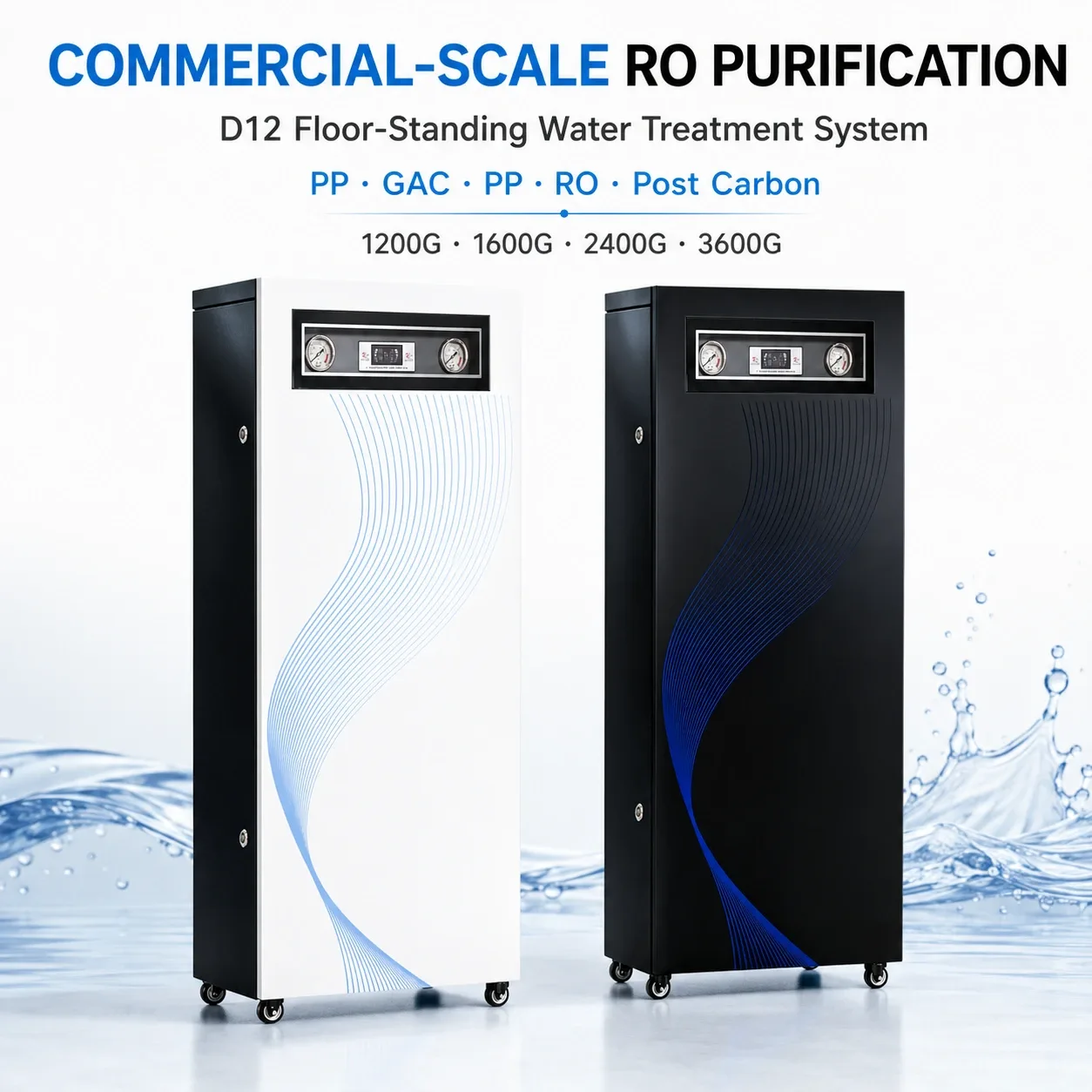
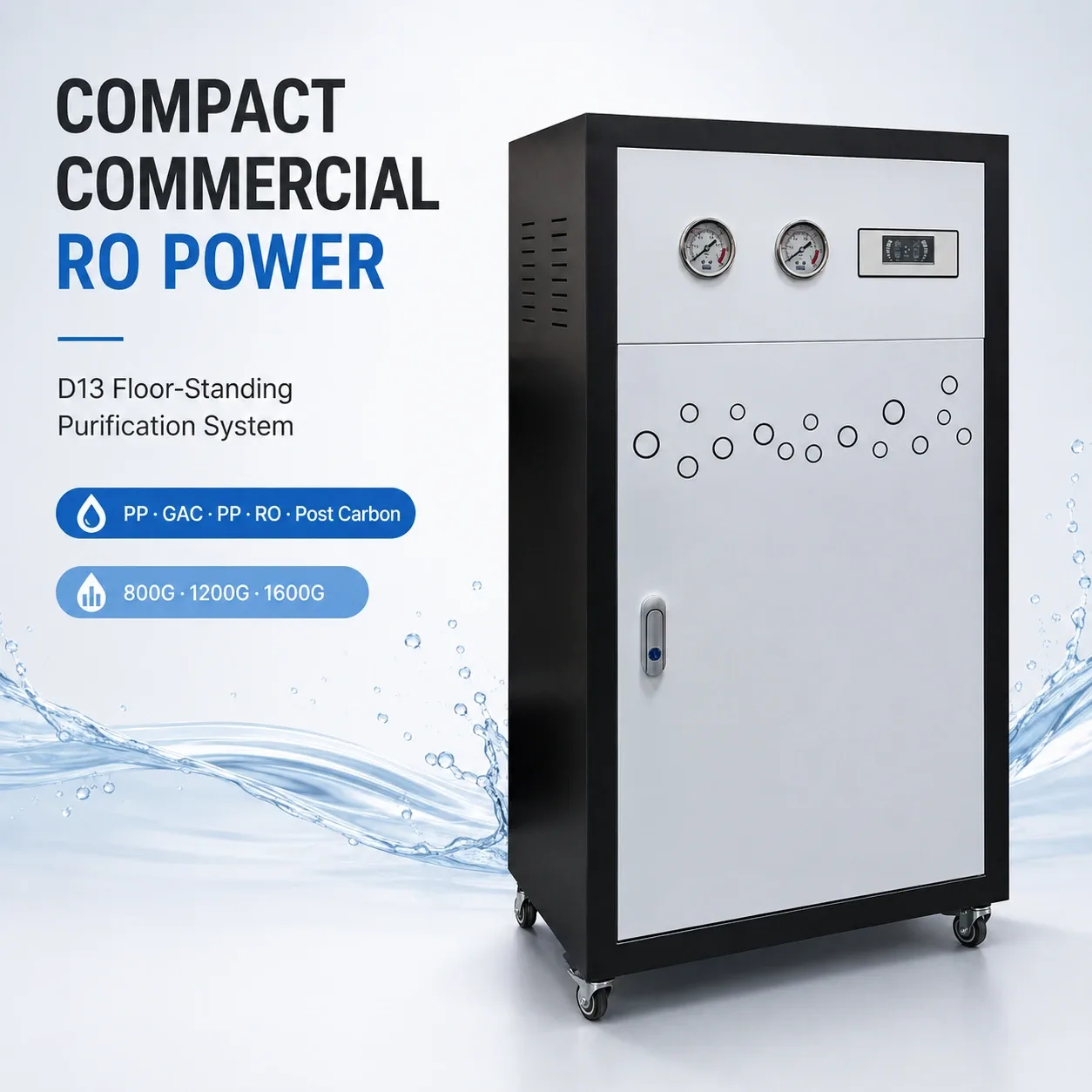
Send your feed-water analysis and demand profile for a project-specific recommendation.